


Free 365 Days Exam Updates NAS-C01 dumps with test Engine Practice
Updated Verified NAS-C01 dumps Q&As - 100% Pass Guaranteed
NEW QUESTION # 202
An ISV is developing a data analytics application using Snowflake Native Apps. The application allows consumers to define custom data refresh schedules. These schedules are managed by stored procedures within the application. The stored procedures need to update a shared table (using SQL MERGE command) located in a different database (managed by the ISV) within the consumer's account. The Application provider doesn't want to give access to the underlying tables to the consumer. To achieve this, which of the following GRANT statements are needed to configure the correct set of privileges for the ISV's Application Role(s) to perform MERGE operations from inside the consumer's environment? (Select all that apply.)
- A. GRANT USAGE ON DATABASE TO ROLE ;
- B. GRANT SELECT ON ALL TABLES IN DATABASE TO ROLE ;
- C. GRANT USAGE ON SCHEMA TO ROLE ;
- D. GRANT INSERT, UPDATE, DELETE ON TABLE .. TO ROLE ;
- E. GRANT ALL PRIVILEGES ON WAREHOUSE TO ROLE ;
Answer: A,C,D
Explanation:
To perform MERGE operations, the ISV application needs the following privileges: USAGE on the ISV database. USAGE on the ISV schema. INSERT, UPDATE, and DELETE on the shared table. SELECT is not enough for MERGE. Granting ALL PRIVILEGES on the warehouse is too broad and unnecessary for the specific task. Granting select on all tables is not required either as you're targeting a single table for DML operation.
NEW QUESTION # 203
You are designing a setup script for a Snowflake Native Application. This script needs to perform the following actions: 1. Create a secure view that exposes a subset of data from a table owned by the provider account. 2. Grant 'SELECT privilege on this secure view to a specific role within the consumer account, but ONLY if that role already exists in the consumer account. 3. Create a UDF in the provider account which calls external function. This UDF needs access to a secret stored in a Snowflake secret object. Which of the following code snippets BEST implements these requirements, ensuring both security and proper privilege management?
- A.

- B.

- C.

- D.
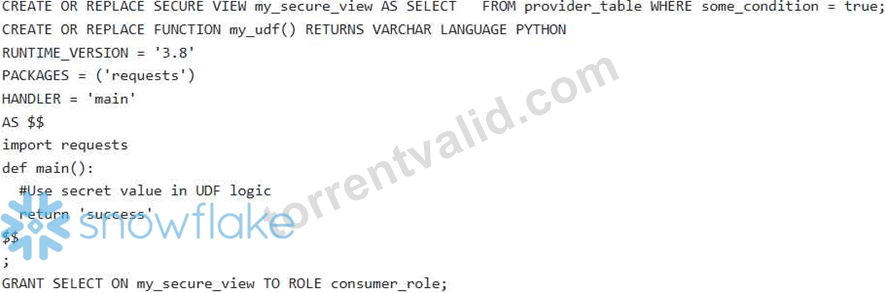
- E.

Answer: B
Explanation:
Option B correctly implements all requirements. It uses a 'BEGIN...ENDS block with an statement to check for the existence of the 'consumer_role' before granting the privilege. This prevents errors if the role doesn't exist. Also it creates a UDF which utilizes Snowflake Secret object to fetch secretes. Using Javascript code inside UDF directly to fetch secrets is not allowed. Options A, C and D do not check for role existence and doesn't configure Snowflake secret object
NEW QUESTION # 204
You are developing a Snowflake Native Application and want to implement a usage-based pricing model. Your application writes usage data to a table 'APPLICATION USAGE' in the provider account. You need to create a listing on the Snowflake Marketplace that charges customers based on the number of processed records. Which of the following steps are crucial to correctly setting up the pricing plan within the listing, ensuring that usage data is properly captured and reflected in the customer's bill?
- A. Define a resource monitor on the provider account that tracks resource consumption of the application, and use this as the basis for pricing. This requires no customer interaction.
- B. Establish a Data Exchange between the provider and consumer accounts, sharing the 'APPLICATION_USAGE' table directly. The listing then references this Data Exchange for pricing.
- C. Configure a usage-based price metric within the listing, pointing it to a secure view created on top of the 'APPLICATION_USAGE' table, explicitly granted to the 'snowflake' account. The secure view should aggregate usage data.
- D. Define a usage-based price metric within the listing that directly queries the 'APPLICATION_USAGE table in the consumer account using a secure view.
- E. Create a stored procedure in the provider account that aggregates the usage data in 'APPLICATION USAGE' , and then configure the listing to execute this stored procedure at regular intervals to calculate charges.
Answer: C
Explanation:
The correct answer is C. A usage-based price metric must point to a secure view that aggregates usage data from the 'APPLICATION_USAGE table. The secure view ensures that data access is controlled and that consumers only see the aggregated usage information required for billing. Option A is partially correct, but misses explicitly granting access to snowflake account, vital for pricing. Other options are incorrect because they either expose raw data (D), rely on procedures which are hard to manage within the marketplace (B), try to query consumer data which is impossible using provider side secure view (A) or irrelevant to usage based pricing (E).
NEW QUESTION # 205
You are developing a Snowflake Native Application that requires specific roles to be assigned to consumers upon installation. Your setup script needs to automatically create these roles if they don't exist and grant appropriate privileges on application objects. Which of the following approaches is the MOST secure and efficient way to achieve this, assuming you want to minimize the attack surface?
- A. Hardcode the role names in the setup script and create them using a stored procedure executed with the 'OWNER privilege. Then, grant the necessary privileges to those roles.
- B. Use a UDF to create the roles and grant privileges. This UDF should be owned by the application and be executed with CALLER's rights.
- C. Dynamically generate SQL statements within the setup script based on a configuration table stored within the application package, then execute these statements to create the roles and grant privileges.
- D. Instruct consumers to manually create the roles and grant privileges after installation, providing them with a separate documentation file containing the necessary SQL commands.
- E. Use a 'CREATE ROLE IF NOT EXISTS' statement within the setup script, followed by 'GRANT statements using the 'APPLICATION' keyword to avoid granting privileges directly to the role within the provider account.
Answer: E
Explanation:
Using 'CREATE ROLE IF NOT EXISTS and granting privileges using the 'APPLICATION' keyword is the most secure and efficient approach. It automates role creation during setup, avoids hardcoding sensitive information, and leverages the application-centric security model of Snowflake Native Apps. Granting privileges to a role within the provider account is generally discouraged for native apps, as it can potentially expose the provider's internal data. Using the APPLICATION keyword ensures the privileges are scoped to the application's context within the consumer's account.
NEW QUESTION # 206
You are packaging a Snowflake Native App that includes Python code and several supporting data files (e.g., configuration files, sample datasets). What are the correct steps to upload these files to a stage for inclusion in your application package, and how do you ensure the Python code is correctly referenced?
- A. Use 'snowcli' to create and manage stages. Structure the application directory appropriately, listing Python code and data files in 'manifest.yml' for correct packaging.
- B. Employ the Snowflake JDBC driver to programmatically upload the files to an internal stage. Update the setup.py file to install the Python dependencies and reference the data files as resources.
- C. Use the 'snowcli' command-line tool to upload the files to a stage. In the setup.py file, ensure that the Python code is referenced correctly, and the data files are listed as package data.
- D. Upload the Python code directly to a Snowflake UDF using the web interface. Upload the data files to an external stage accessible via a URL, and reference them in the application code.
- E. Use the Snowflake web interface to upload all files to an internal stage. Reference the Python code within the setup.py file using relative paths.
Answer: A,C
Explanation:
'snowcli' is the recommended tool for managing Snowflake Native App development, including stage management and file uploads. The 'setup.py' file is crucial for specifying dependencies and including data files as package data. Newer native apps use 'manifest.ymr to declare stage resources and dependencies. Using JDBC for uploading is possible, but less convenient than 'snowcli' . Referencing files via URLs from external stages introduces unnecessary complexity and security risks. Direct uploading to UDFs is not a method for including all app assets.
NEW QUESTION # 207
You are preparing to list your Snowflake Native Application on the Snowflake Marketplace. You've developed the application and implemented security measures. Which of the following steps are essential best practices for ensuring a successful and secure listing on the Snowflake Marketplace?
- A. Implement robust error handling and logging mechanisms to provide consumers with informative error messages and aid in troubleshooting. Include mechanisms for securely collecting and storing application usage metrics (if required), ensuring compliance with privacy regulations.
- B. Clearly communicate the application's security model, including data encryption methods, access controls, and any reliance on consumer-side security configurations. Undergo and document regular security audits and penetration tests of the application.
- C. Include a prominently displayed disclaimer stating that the application is provided "as is" and the provider assumes no liability for any damages arising from its use. Only provide basic installation instructions. It is the end user's responsibility to know how to use the application.
- D. Thoroughly document the application's functionality, installation instructions, configuration options, and any known limitations. Provide clear and concise pricing information and support contact details.
- E. Avoid documenting any limitations or potential issues with the application to present a flawless image to potential consumers. Only provide limited pricing information to create a sense of urgency to potential consumer
Answer: A,B,D
Explanation:
Options A, B, and C are essential best practices. Thorough documentation (A) is crucial for consumer adoption. Robust error handling and logging (B) improve the user experience and facilitate troubleshooting. Clear communication of the security model (C) builds trust. Option D is unacceptable as it shifts responsibility unfairly to the consumer. Option E is also unethical, as consumers should know what to expect.
NEW QUESTION # 208
You are designing a Streamlit application within a Snowflake Native App package. This application displays data from a customer's Snowflake account. The application needs to enforce strict data governance policies, ensuring that users only see the data they are authorized to view based on their roles and permissions within the customer's account. Which strategies and Snowflake features should be employed to achieve this?
- A. Implement row-level security policies directly within the Streamlit application using Python code to filter the data.
- B. Create separate Streamlit applications for each user role, each with its own data access configuration.
- C. Leverage Snowflake's row access policies to automatically filter data based on the user's role and context at the database level.
- D. Use Snowflake's masking policies to redact sensitive data based on the user's role and context at the database level.
- E. Use external tables to fetch the data.
Answer: C,D
Explanation:
Row access policies (B) are the recommended approach for implementing row-level security in Snowflake, as they are applied at the database level and ensure consistent enforcement regardless of the application accessing the data. Masking policies (D) are crucial for redacting sensitive information based on user roles. Implementing data filtering within the Streamlit application (A) is less secure and harder to maintain. Creating separate applications for each role (C) is inefficient and not scalable. External tables are for accessing data outside of Snowflake not controlling access to existing data.
NEW QUESTION # 209
You are developing a Snowflake Native Application that interacts with a user-provided data source. The application needs to validate that the user has granted the necessary permissions on their dat a. The application package contains the following setup script:
Which of the following approaches is the MOST secure and reliable way to check for SELECT privileges within the procedure?
- A. Assume SELECT privileges are granted as part of the application installation process without explicit validation.
- B. Use 'SHOW GRANTS TO ROLE app_role' and parse the output to see if SELECT privilege on 'user_schema.user_table' exists.
- C. Attempt a 'SELECT COUNT( ) FROM within a "TRY...CATCH' block and infer permissions based on the error message.
- D. Use function with appropriate parameters to directly check if the 'app_role' has SELECT privilege on 'user schema.user table'.
- E. Query the 'INFORMATION SCHEMA.TABLE PRIVILEGES' view to check if 'app_role' has SELECT privilege on 'user_schema.user_table'.
Answer: D
Explanation:
'SYSTEM$PRIVILEGE_CHECK' is the recommended and most secure method. It directly checks for the existence of a specified privilege for a role on an object. Parsing the output of 'SHOW GRANTS' is less reliable and prone to errors. 'TRY...CATCH' is inefficient and relies on error message parsing, which is discouraged. provides metadata but not a definitive check in the context of the application role having the necessary grants made by the consumer. Assuming privileges are granted is a security risk.
NEW QUESTION # 210
You are designing a Snowflake Native Application that utilizes Snowpark Container Services to provide a data enrichment service for customer dat a. This service requires the application to securely store and manage API keys and other sensitive configuration data. Which of the following methods offers the MOST secure and compliant approach for managing these secrets within the context of a Snowflake Native Application deployed in the customer's environment?
- A. Storing the API keys directly within the container's environment variables during the container build process.
- B. Encrypting the API keys using a symmetric key and storing them in a Snowflake table. The container retrieves and decrypts the keys at runtime.
- C. Leveraging Snowflake secrets to securely store and manage the API keys. The container retrieves the secrets at runtime using the Snowflake API or Snowpark.
- D. Hardcoding the API keys within the application's source code. The source code is obfuscated to make it difficult to extract the keys.
- E. Storing the API keys in an external key management system (KMS) and granting the container access to the KMS using its assigned service account.
Answer: C
Explanation:
Option C is the most secure and compliant approach. Snowflake secrets provide a secure and managed way to store and manage sensitive data within the Snowflake environment. The container can retrieve the secrets at runtime using the Snowflake API or Snowpark, without exposing the keys directly in the container image or environment variables. Option A is insecure. Option B requires key management. Option D is complex and depends on external systems. Option E is highly insecure.
NEW QUESTION # 211
A customer has installed your Snowflake Native Application, which utilizes a IJDF that performs complex calculations. The customer reports performance issues and sporadic errors. As the application provider, how can you BEST establish telemetry and observability to diagnose the problem, without compromising the customer's data security or privacy?
- A. Create a shared view on the UDF execution logs in the customer's account, granting you read-only access to the relevant information.
- B. Request direct access to the customer's Snowflake account to inspect the IJDF execution logs and query performance metrics.
- C. Implement logging within the UDF to capture execution time, input parameters (anonymized), and error messages. Store this data in an Event Table within the application provider's account and expose aggregate statistics through a secure API endpoint for the consumer to monitor.
- D. Instruct the customer to enable verbose logging in their Snowflake account and provide you with the log files for analysis.
- E. Utilize Snowflake's Query History to track the IJDF's performance in the customer's account and provide recommendations based on the observed query patterns.
Answer: C
Explanation:
Option B provides a balanced approach to observability and security. By logging anonymized input parameters and execution time within the IJDF and storing the data in an Event Table in the application provider's account, you can analyze performance and identify errors without directly accessing the customer's sensitive data. Exposing aggregate statistics allows the customer to monitor the application's performance. The other options either compromise security or rely on the customer to provide data, which might not be feasible or secure.
NEW QUESTION # 212
You are developing a Snowflake Native Application that manages customer accounts. In version 1.0, you had a table named 'CUSTOMER_ACCOUNTS with columns 'ACCOUNT D', 'CUSTOMER NAME, and 'EMAIL'. You are now releasing version 2.0, which requires adding a new column 'PHONE NUMBER to the 'CUSTOMER ACCOUNTS table, but you need to ensure backward compatibility and allow seamless upgrades for existing installations. Which of the following approaches within the 'setup.sqr file is the MOST robust and reliable to implement this schema change without disrupting existing users?
- A.

- B.

- C.

- D.

- E.

Answer: D
Explanation:
Option E is the most robust because it explicitly checks for the existence of the column before attempting to add it. This prevents errors during upgrade if the column already exists (e.g., if a previous upgrade failed partially). Using a stored procedure within 'setup.sqr provides more control and avoids syntax errors that might arise from 'IF statements directly in the script. Option A, B and C would fail if the column already exists, throwing an error and halting the upgrade process. Option D is destructive, as it drops and recreates the table, leading to data loss. Therefore, option E is the most reliable and production-ready.
NEW QUESTION # 213
You are developing a Snowflake Native Application that requires robust role-based access control. The application provides data transformation services to consumer accounts. You want to define distinct roles for different levels of access: 'TRANSFORMER_ADMIW (full control), 'TRANSFORMER USER (execute transformations), and 'TRANSFORMER OBSERVER (read-only access to metadata). In the setup script, which SQL statements are the MOST secure and efficient way to achieve this while adhering to Snowflake's recommended practices for application roles?
- A.

- B.

- C.

- D.

- E.

Answer: D
Explanation:
Option E is the MOST secure and recommended approach. It explicitly grants ownership to the role on the 'DATABASE and the 'SCHEMA' named 'app_stage' within the 'DATABASE. 'REVOKE CURRENT GRANTS' ensures that any previously granted privileges are removed, preventing unintended access. All roles are created within the 'app_public' schema to ensure they are application roles. All other roles are granted usage on the database and application schema in the 'app_db' database. Option A uses a naming convention where the schema names are identical to the role names, which is unusual and doesn't represent standard practices for Snowflake native applications. Options B lacks the important practice of creating the roles within the 'app_public' schema, rendering them non-application roles. Options C and D incorrectly refers to 'app_stage' outside the 'app_db' database, as it is not an fully qualified name.
NEW QUESTION # 214
A Snowflake Native App provider wants to ensure that even future roles created in their provider account will NOT automatically have access to the application database , which was created without the "MANAGED ACCESS' property initially. After creating a security audit suggested it to be with managed access. Which of the following steps BEST secures the app database?
Note multiple options may be needed
- A. REVOKE USAGE ON DATABASE FROM ROLE PUBLIC;
- B. ALTER DATABASE SET MANAGED ACCESS = TRUE;
- C. REVOKE ALL PRIVILEGES ON DATABASE FROM PUBLIC;
- D. DROP DATABASE CREATE DATABASE WITH MANAGED ACCESS;
- E. GRANT OWNERSHIP ON DATABASE TO ROLE application_role;
Answer: B,C,E
Explanation:
The most effective method is to use 'ALTER DATABASE SET MANAGED_ACCESS = TRUE;' to enable managed access. This ensures that privileges are managed at the database level. Revoking all privileges from PUBLIC removes default access granted to all roles (including future roles). By revoking default public access and using managed access together, one ensures greater security. Option A works, but dropping and recreating is impactful. Option D, is similar to C however doesn't handle future role. Granting ownership to a specific role ensures better control.
NEW QUESTION # 215
You are developing a Snowflake Native App using Python that performs complex data transformations using UDFs and external functions. During consumer testing, you observe intermittent 'Remote service timed out' errors when calling the external function. The external function is hosted on AWS Lambd a. Which combination of the following actions would BEST address this issue, ensuring reliability without compromising security?
- A. Migrate the external function to a Snowflake Java UDF to minimize network latency, and reduce the payload size sent to the external function. Verify that the AWS Lambda function and Snowflake instance are in the same region.
- B. Increase the timeout setting for the external function in Snowflake, optimize the Lambda function code for faster execution, and monitor Lambda function metrics (e.g., duration, errors) using CloudWatch. Also, increase the memory allocation for the AWS Lambda function.
- C. Implement queue-based processing for external function calls using Snowflake streams and tasks, leverage a message queue service (e.g., SQS) to buffer requests, and ensure the Lambda function has sufficient concurrency and is not being throttled.
- D. Implement retry logic in the Python code calling the external function with exponential backoff, and configure Snowflake to use a larger warehouse size to improve network bandwidth. Furthermore, check if AWS Lambda throttles the execution of requests.
- E. Cache the results of the external function calls in a Snowflake table to reduce the number of calls to the external service, and implement robust error handling and logging in both the Snowflake UDF and the Lambda function. Always return a value, even in case of error.
Answer: B
Explanation:
Increasing the timeout in Snowflake, optimizing the Lambda function's performance (including code optimization and increasing memory allocation), and monitoring Lambda metrics are critical for addressing timeout issues. Lambda timeouts can occur if the function takes too long to execute, so increasing the timeout and optimizing performance can directly mitigate this. Furthermore, checking Lambda function metrics in CloudWatch can provide valuable insights into the root cause of performance problems. This combination tackles both the symptom (timeouts) and potential underlying causes (slow execution, resource constraints). Other answers only deal with some of the issues; without a performance-focused perspective, the problem could persist.
NEW QUESTION # 216
You are developing a Snowflake Native Application that utilizes Snowpark Container Services to perform complex image processing. The application needs to securely access data stored in the consumer's Snowflake account, specifically a table named 'USER IMAGES' in the schema 'RAW DATA'. The container image is built and pushed to Snowflake's internal registry. Which of the following steps are necessary to ensure the container service can access this data securely and efficiently within the consumer's account without exposing credentials directly in the container environment?
- A. Configure a Snowflake OAuth integration and associate it with the container service. The container application would then use the OAuth client credentials to obtain an access token and authenticate with Snowflake.
- B. Create a Snowflake database role, grant SELECT privileges on ' to this role, and then assign this role to the service account used by the container service through an entitlement.
- C. Create a Snowflake service account and grant it SELECT privileges on the 'RAW DATA.USER IMAGES table. Store the service account's credentials as environment variables within the container service's specification.
- D. Grant the SNOWFLAKE CONTAINER SERVICE role to the account administrator and use the administrator's credentials within the container service's code.
- E. Create a Snowflake network rule that allows access to all Snowflake internal IPs. Associate this rule with the container service's network policy.
Answer: B
Explanation:
The most secure and efficient way to grant access is to use database roles and entitlements. Creating a database role with the required privileges, assigning it to the service account of the container service through an entitlement provided to consumer is the recommended approach. This avoids storing credentials directly and provides fine-grained access control. Using SNOWFLAKE_CONTAINER_SERVICE role is too broad and admin credentials should never be used directly in the code. Storing service account credentials in environment variables is insecure. OAuth is not directly used for container services accessing data within the consumer's account in this manner; entitlements offer a more streamlined and secure approach. Network Rules control egress traffic, not access to Snowflake data within the account.
NEW QUESTION # 217
......
Provide Valid Dumps To Help You Prepare For SnowPro Specialty - Native Apps Exam: https://freedumps.torrentvalid.com/NAS-C01-valid-braindumps-torrent.html