


Verified & Correct CPHQ Practice Test Reliable Source Oct 03, 2026 Updated
Free NAHQ CPHQ Exam Files Downloaded Instantly
NEW QUESTION # 344
Analysis has shown that there Is a significant delay in receiving laboratory results In the emergency room. A cross-functional team Is assigned the task of Improving laboratory reporting time. Which of the following Is the next step the team should take?
- A. Plot a scatter diagram.
- B. Develop action plans.
- C. Identify the responsible Individual.
- D. Complete a fishbone diagram.
Answer: D
Explanation:
When a cross-functional team is assigned the task of improving a process, such as laboratory reporting time in the emergency room, the first step after identifying the problem is usually to understand the root causes of the problem. A fishbone diagram, also known as a cause and effect diagram or Ishikawa diagram, is a visual tool used to systematically identify and present all possible causes of a certain outcome1234.
In this case, the significant delay in receiving laboratory results is the problem that needs to be addressed. The team would use a fishbone diagram to identify and categorize potential reasons for this delay, such as equipment issues, process inefficiencies, human errors, etc. This step is crucial before developing action plans (Option D) because it ensures that the team's efforts are directed towards addressing the root causes of the problem, rather than just the symptoms1234.
Options A (Identify the responsible individual) and C (Plot a scatter diagram) are not the immediate next steps in this scenario. Identifying a responsible individual is more about accountability after the root causes have been identified and action plans have been developed. A scatter diagram is a graphical tool used to understand the relationship between two variables and is not typically the next step in process improvement after identifying the problem1234.
References:
https://fellow.app/blog/management/cross-functional-collaboration-common-challenges-and-tips-to-make-it- work/\
NEW QUESTION # 345
A quality professional has been asked to assist with prioritizing quality performance Initiatives In the surgery department. Given the Information In the matrix below, which of the following performance Initiatives should take priority?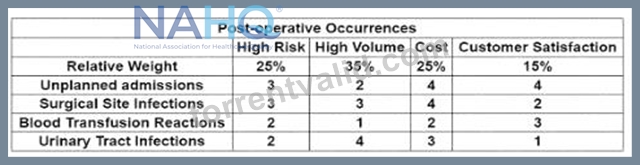
- A. Reduce urinary tract Infections.
- B. Reduce blood transfusion reactions.
- C. Reduce unplannedreadmissions.
- D. Reduce surgical site Infections.
Answer: D
Explanation:
According to the provided matrix, surgical site infections have high relative weight in both risk and volume, and also score the highest in terms of cost, indicating that they are frequent, carry significant risk, and are costly. While customer satisfaction is lower for urinary tract infections (UTIs), the higher relative weight and cost associated with surgical site infections suggest they have a more significant impact on overall quality and resource use. Therefore, focusing on reducing surgical site infections aligns with prioritizing initiatives that have the potential for the greatest impact on patient safety and resource utilization.
References:This recommendation is consistent with the NAHQ's emphasis on using data to prioritize quality initiatives, focusing on areas that have the highest impact on patient outcomes and healthcare costs. The NAHQ Healthcare Quality Competency Framework also discusses the importance of data analysis in the Performance and Process Improvement domain to prioritize improvements in healthcare quality and safety.
NEW QUESTION # 346
A nursing director for a unit in a cancer hospital Is reviewing and assessing outcomes data in the following scatter diagram: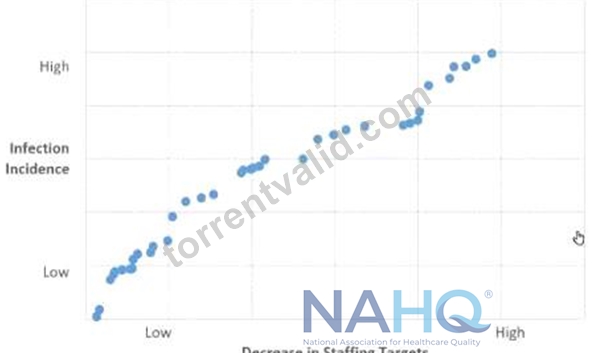
The relationship between the incidence of infection and the decrease in staffing targets is
- A. strong and negative.
- B. weak and positive.
- C. weak and negative.
- D. strong and positive.
Answer: A
Explanation:
The scatter diagram shows that as the decrease in staffing targets becomes more significant (moving right on the horizontal axis), the incidence of infection goes up (moving up on the vertical axis). This indicates a negative relationship because as one variable increases, the other one decreases. The relationship appears to be strong because the points lie closely to an imaginary line that slopes upwards from left to right, which suggests a consistent trend across the data points.
References:In healthcare quality improvement, it is critical to use data to inform decision-making. Scatter diagrams are a common tool used for this purpose. The NAHQ Healthcare Quality Competency Framework emphasizes the importance of analyzing and utilizing data in decision-making, as indicated in the Performance and Process Improvement domain. A strong negative relationship in this context could indicate that decreased staffing levels are associated with higher infection rates, which is a significant finding for a nursing director assessing outcomes and considering quality improvement initiatives.
NEW QUESTION # 347
The preferred culture in promoting patient safety
- A. uses anonymous reporting and audits standards.
- B. fosters collaboration and uses anonymous reporting.
- C. auditsstandards and promotes learning from mistakes.
- D. promotes learning from mistakes and fosters collaboration.
Answer: D
Explanation:
The preferred culture in promoting patient safety is one that promotes learning from mistakes and fosters collaboration. This is because a culture that promotes learning from mistakes encourages a non-punitive environment where individuals feel safe to report errors and near misses. This openness allows for the identification of systemic issues that can be addressed to prevent future errors1.
On the other hand, fostering collaboration is crucial in patient safety as it encourages open communication and teamwork among healthcare professionals. Collaboration ensures that all team members can contribute their expertise to patient care, which can lead to improved patient outcomes23.
References:
Clinical nurse competence and its effect on patient safety culture: a systematic review1 Patient safety culture: a systematic review by characteristics of Hospital Survey on Patient Safety Culture dimensions2 Key drivers of promoting patient safety culture from the perspective of3
NEW QUESTION # 348
A patient safety program can best be enhanced by which of the following technologies?
- A. barcode system for medication administration
- B. computers on wheels at the patients' bedsides
- C. digital medication reference materials
- D. online evidence-based medicine guidelines
Answer: A
NEW QUESTION # 349
Supporting patients through longitudinal care plans is the guiding principle of:
- A. Care coordination.
- B. Team-based care.
- C. Patient engagement.
- D. Emerging healthcare models.
Answer: A
Explanation:
Comprehensive and Detailed Explanation From Exact Extract:
Within the Population Health and Care Transitions domain, the principle of care coordination is defined as organizing patient care activities and sharing information among all participants involved in a patient's care to achieve safer and more effective outcomes.
The use of longitudinal care plans - ongoing, comprehensive plans that span multiple settings and providers
- directly reflects this guiding principle. These plans ensure that patients receive coordinated, consistent care over time, minimizing duplication and improving outcomes.
Team-based care and patient engagement are important elements that support coordination, but the core guiding principle underlying longitudinal care management is care coordination.
References:
NAHQ CPHQ Content Outline - Population Health and Care Transitions: Care Coordination, Continuity of Care, and Longitudinal Care Planning NAHQ Healthcare Quality Competency Framework - Population Health and Care Transitions: Coordination of Care Across Settings and Time
NEW QUESTION # 350
___________________ is a difference between an observed event and a standard or norm. Without this standard, or, best practice, measurement of variation offers little beyond a description of the observations.
- A. Process variation
- B. Variation
- C. Assignable variation
- D. Random variation
Answer: B
NEW QUESTION # 351
An organization's culture is best assessed by examining the
- A. collaboration of medical staff and administration.
- B. behavioral alignment with the core values.
- C. number of performance improvement activities.
- D. involvement of each patient care department in strategic planning.
Answer: B
Explanation:
An organization's culture is best assessed by examining the behavioral alignment with its core values. Culture is reflected in how closely the actions, decisions, and behaviors of employees at all levels align with the organization's stated values. When there is strong alignment, it indicates a cohesive culture that reinforces the organization's mission and vision. Conversely, a disconnect between behaviors and core values can signal cultural issues that need to be addressed.
* Collaboration of medical staff and administration (B): Collaboration is important but is just one aspect of culture.
* Number of performance improvement activities (C): The quantity of activities doesn't necessarily reflect cultural values or behaviors.
* Involvement of each patient care department in strategic planning (D): While important, involvement in planning is more related to governance and strategy than to overall culture.
References
* NAHQ Body of Knowledge: Organizational Culture and Core Values
* NAHQ CPHQ Exam Preparation Materials: Assessing and Aligning Organizational Culture
=========
NEW QUESTION # 352
A hospital's Quality Council has prioritized four quality improvement initiatives using the following matrix:
Quality Improvement Initiative
Relation to Strategic Plan
Overall Positive Patient Impact
Degree of Risk to Patient
Reduce patient falls by 10%
100
20
60
Reduce wrong-site surgeries to zero
90
60
90
Reduce medication dispensing time by 20%
90
80
30
Reduce central line infections by 30%
40
90
90
Which initiative should be the highest priority?
- A. Wrong-site surgeries
- B. Central line infections
- C. Falls
- D. Medication dispensing time
Answer: A
Explanation:
Under the Organizational Leadership domain, NAHQ emphasizes the use of prioritization matrices to align improvement initiatives with strategic goals, patient impact, and risk.
By summing the weighted scores:
* Falls: 180
* Medication dispensing time: 200
* Central line infections: 220
* Wrong-site surgeries: 240
Wrong-site surgery reduction has the highest total score and addresses a never event with severe patient harm and regulatory implications. NAHQ guidance prioritizes initiatives with high risk and strong strategic alignment. Therefore, Option D represents the highest priority.
NEW QUESTION # 353
A quality improvement professional believes that their MRSA facility rates are high. What should the quality improvement professional do first?
- A. Repeat the data collection process to Justify the new rate.
- B. Report the concerns to senior management and the Quality Council.
- C. Form a quality improvement team.
- D. Contact the infection control practitioner to obtain benchmark data.
Answer: D
Explanation:
* The first step for a quality improvement professional who believes that their MRSA facility rates are high is to contact the infection control practitioner to obtain benchmark data. Benchmark data are comparative data that can help identify gaps in performance and set realistic and achievable goals for improvement 1. Benchmark data can beobtained from various sources, such as national or regional databases, professional organizations, peer-reviewed literature, or other similar facilities 2.
* By contacting the infection control practitioner, the quality improvement professional can access reliable and valid data on MRSA rates in their facility and compare them with other facilities or standards. This can help them determine the magnitude and significance of the problem, and whether it warrants further investigation and action. The infection control practitioner can also provide guidance on the best practices and protocols for preventing and controlling MRSA infections, and the potential risk factors and causes of high MRSA rates 3.
* The other options are not the best first steps for the quality improvement professional. Reporting the concerns to senior management and the Quality Council (option B) may be premature and unnecessary without having sufficient evidence and analysis of the problem. Forming a quality improvement team (option C) may be helpful later in the process, but not before defining and measuring the problem.
Repeating the data collection process to justify the new rate (option D) may be wasteful and inaccurate, as it may not account for the variability and trends in the data, and it may not address the underlying causes of the problem . References:
* 1: NAHQ Healthcare Quality Competency Framework, Domain 5: Data Analytics, Skill 5.1.1
* 2: Benchmarking in Healthcare: A Practical Approach | NAHQ
* 3: Success and failures in MRSA infection control during the COVID-19 pandemic | Antimicrobial Resistance & Infection Control | Full Text 2
* : NAHQ Healthcare Quality Competency Framework, Domain 3: Performance and Process Improvement, Skill 3.1.1
NEW QUESTION # 354
A local health center is launching a community health assessment. What data is recommended to identify the potential needs of the population?
- A. highest level of education of healthcare professionals
- B. zip codes for patients frequently using the emergency department
- C. number of fast food restaurants in the area
- D. top five diagnoses for patient visits
Answer: D
Explanation:
When launching a community health assessment, identifying the top five diagnoses for patient visits is recommended to understand the prevalent health issues within the population. This data helps pinpoint the most common health concerns and prioritize areas for intervention and resource allocation. It provides a clear picture of the community's health needs, which is essential for planning effective public health strategies.
* Zip codes for patients frequently using the emergency department (A): This can identify geographic areas of need but does not provide direct information on the types of health issues prevalent in the community.
* Highest level of education of healthcare professionals (B): This is related to workforce capabilities rather than community health needs.
* Number of fast food restaurants in the area (D): While relevant to understanding certain social determinants of health, it does not directly identify specific health needs.
References
* NAHQ Body of Knowledge: Community Health Assessment and Needs Identification
* NAHQ CPHQ Exam Preparation Materials: Data Collection for Community Health Improvement
=========
NEW QUESTION # 355
A new process improvement team has just completed unstructured brainstorming on reasons why healthcare- acquired infection rates are increasing. Which tool would be most helpful to sort through brainstorming ideas?
- A. affinity diagram
- B. Pareto chart
- C. decision matrix
- D. force field analysis
Answer: A
Explanation:
Explanation: An affinity diagram (C) organizes brainstorming ideas into thematic categories, aiding analysis of infection rate causes. Decision matrices (A), Pareto charts (B), and force field analysis (D) are less suited for sorting ideas. NAHQ emphasizes affinity diagrams for idea organization.
NAHQ CPHQ Study Guide, Performance and Process Improvement Section, "Affinity Diagrams and Idea Organization"; NAHQ CPHQ Practice Questions, Quality Improvement Tools.
NEW QUESTION # 356
A stated purpose of the National Committee for Quality Assurance (NCQA) Healthcare Effectiveness Data and Information Set (HEDIS) public reporting is that accountable health care should:
- A. Validate patient experience and satisfaction with care
- B. Provide valid and reliable data
- C. Require both measurement and transparency
- D. Ensure data is collected and reported annually
Answer: C
Explanation:
Detailed Explanation:
HEDIS's goal is to ensure measurement and transparency in healthcare performance, making it possible to compare providers on standardized metrics.
Option C: Require both measurement and transparency
This aligns with NCQA's mission to promote accountability and transparency in healthcare.
References:
The CPHQ study materials on HEDIS emphasize measurement and transparency as core objectives of NCQA's public reporting standards.
NEW QUESTION # 357
Which of the following would be the best source for the performance improvement manager to use to externally benchmark the occurrence of central line infections?
- A. National Quality Forum (NQF)
- B. National Institutes of Health (NIH)
- C. National Healthcare Safety Network (NHSN)
- D. Agency for Healthcare Research and Quality (AHRQ)
Answer: C
Explanation:
Under the Health Data Analytics domain, NAHQ emphasizes the use of standardized, nationally recognized data sources for external benchmarking. The National Healthcare Safety Network (NHSN) is the primary surveillance system used for tracking healthcare-associated infections, including central line-associated bloodstream infections (CLABSIs).
NHSN provides risk-adjusted benchmarks, standardized definitions, and national comparison data, making it the most appropriate source for external benchmarking. NIH focuses on research, NQF endorses measures but does not collect performance data, and AHRQ provides tools and reports rather than infection surveillance data. Therefore, Option B is the correct and exam-aligned answer.
NEW QUESTION # 358
A patient safety manager is asked to recommend the best action to reduce medication errors at a hospital.
Which of the following is the most appropriate next step?
- A. Drill down on the data to identify trends before making recommendations.
- B. Re-educate the nursing staff on correct medication administration procedures.
- C. Conduct research on implementation of a bar code medication administration system.
- D. Ask the unit managers to counsel staff following medication errors.
Answer: A
Explanation:
The most appropriate next step for the patient safety manager in reducing medication errors is to drill down on the data to identify trends before making recommendations. Understanding the underlying causes and patterns of medication errors through data analysis is essential for developing targeted and effective interventions. By identifying trends, the safety manager can focus on the specific areas that need improvement, ensuring that any actions taken are evidence-based.
* Re-educate the nursing staff on correct medication administration procedures (A): Education may be necessary but should be informed by an understanding of the root causes of errors.
* Conduct research on implementation of a bar code medication administration system (B): This could be a potential solution, but it should follow a thorough analysis of error trends.
* Ask the unit managers to counsel staff following medication errors (C): This addresses individual errors but does not tackle systemic issues that may be identified through data analysis.
References
* NAHQ Body of Knowledge: Data Analysis in Patient Safety
* NAHQ CPHQ Exam Preparation Materials: Medication Error Reduction Strategies
=========
NEW QUESTION # 359
......
The Certified Professional in Healthcare Quality (CPHQ) examination is a globally recognized certification for healthcare quality professionals. It is administered by the National Association for Healthcare Quality (NAHQ), a professional organization that promotes healthcare quality through education, certification, and networking opportunities. The CPHQ certification demonstrates a healthcare professional's expertise in quality management, patient safety, and performance improvement.
The CPHQ exam is designed to assess the knowledge and skills of healthcare quality professionals across a range of domains. These domains include healthcare quality and performance improvement, leadership and management, information management, and patient safety. CPHQ exam is intended to evaluate the competencies of professionals across a broad range of healthcare settings, including hospitals, long-term care facilities, and ambulatory care settings.
Pass NAHQ CPHQ exam Dumps 100 Pass Guarantee With Latest Demo: https://freedumps.torrentvalid.com/CPHQ-valid-braindumps-torrent.html